Performance metrics explained
What TVPI, DPI, RVPI, IRR and MOIC mean in plain words, one worked example, and how Investryx computes them for you.
The Performance screen reduces a fund to six numbers. This article explains what each one means, walks through one small example, and says where Investryx gets the inputs. You never calculate these yourself; Investryx computes them from the positions, capital calls and distributions you record.
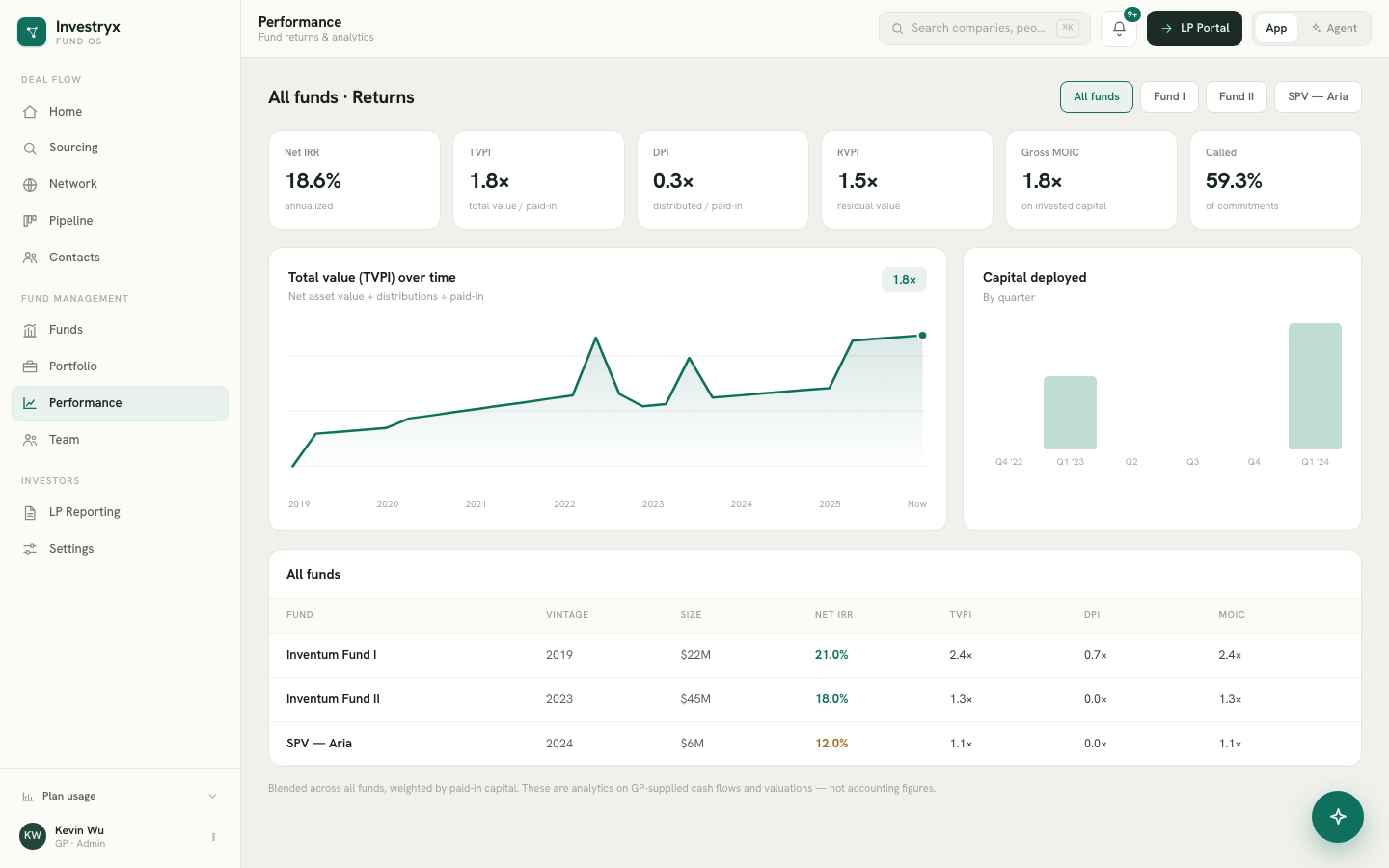
The screen
Use the fund pills at the top to look at All funds blended or one fund. Below the metric cards are a Total value (TVPI) over time chart, a Capital deployed by-quarter chart and an All funds comparison table with vintage, size, Net IRR, TVPI, DPI and MOIC. Every view carries the same footnote: these are analytics on GP-supplied cash flows and valuations, not accounting figures. Your fund administrator’s statements remain the official record.
Two words first
- Paid-in capital is the money LPs have actually sent the fund in response to capital calls. It is smaller than committed capital until the fund is fully called.
- NAV, or residual value, is what the fund’s remaining holdings are worth today at their latest marks.
The metrics
TVPI — total value to paid-in
Everything the fund has produced, realised or not, per dollar paid in.
TVPI = (distributions + NAV) ÷ paid-in
A TVPI of 1.0× means LPs are whole on paper; 2.0× means the fund has doubled their money on paper. It says nothing about how much has actually been returned, which is why it is read alongside DPI.
DPI — distributions to paid-in
Cash actually returned to LPs per dollar paid in.
DPI = distributions ÷ paid-in
DPI is the number LPs trust most, because it cannot be marked up. Early in a fund’s life it is 0.0×.
RVPI — residual value to paid-in
The unrealised part: what is still held, per dollar paid in.
RVPI = NAV ÷ paid-in
TVPI is always DPI plus RVPI. As a fund matures, value should migrate from RVPI to DPI.
MOIC — multiple on invested capital
A multiple on the money invested rather than the money called. For a single position, MOIC = (current value + realised proceeds) ÷ amount invested; that is the MOIC column on Portfolio. Gross MOIC on Performance is the same idea for the whole fund, before fees and carry, which is why it is normally higher than TVPI.
Net IRR — internal rate of return
The annualised rate of return implied by the timing of every cash flow: calls out, distributions in, and NAV as if it were returned today, after fees and carry. Two funds with the same 2.0× TVPI can have very different IRRs — the one that returned money sooner has the higher IRR. IRR rewards speed; multiples reward size. Read both.
Called
The share of committed capital that has been called so far, from the capital-call ledger.
One worked example
A fund has $10M committed and has called $6M so far. It has distributed $1.5M to LPs, and its remaining holdings are marked at $7.5M.
| Metric | Calculation | Result |
|---|---|---|
| Called | 6 ÷ 10 | 60% |
| DPI | 1.5 ÷ 6 | 0.25× |
| RVPI | 7.5 ÷ 6 | 1.25× |
| TVPI | (1.5 + 7.5) ÷ 6 | 1.50× |
Inside that fund, one position cost $1.0M and is now marked at $2.5M with nothing realised: its MOIC is 2.5×.
Where the inputs come from
- Paid-in and Called come from the capital calls you issue on the fund’s Funds page.
- Distributions come from the distributions you record there.
- NAV is the sum of position values — each position’s ownership applied to its latest recorded round, or the current value you entered.
- The TVPI over time curve interpolates each position’s value between its recorded rounds, adds distributions and divides by paid-in at each quarter end, ending at the headline TVPI.
- Capital deployed sums the rounds your fund participated in, by quarter.
- All funds blends each metric across funds weighted by paid-in capital. Holdings in other currencies are translated at period-end rates for display only; if that matters, an FX line under the metrics says how much of the return is currency.
Because everything flows from the ledgers, keeping capital calls, distributions, rounds and exits recorded promptly is what keeps Performance right.